
Ehsaas Program and Its Sub-Programs Explained
Most people have heard of the Ehsaas Program but many do not know how big it actually is. The Ehsaas Program is not just one scheme. It is an umbrella of many different programs each designed to help a different group of people. This blog explains the full Ehsaas Program and all its major sub-programs in simple language.
What is the Ehsaas Program
The Ehsaas Program was launched in 2019 by the Government of Pakistan. The main goal was to reduce poverty, reduce inequality between rich and poor, and lift the most vulnerable people out of financial hardship. Ehsaas means empathy in Urdu and the name reflects the idea that the government should feel the pain of its poorest citizens and act on it.
From the day it launched Ehsaas became one of the largest social protection efforts in Pakistan’s history. It brought together dozens of different welfare initiatives under one roof with a shared goal of helping the people who need it most.
Why the Ehsaas Program Was Needed
Pakistan has always had a large population living below the poverty line. Rising food prices, unemployment, floods, and economic instability made things worse for millions of families over the years. At the same time many existing welfare programs were poorly managed, prone to corruption, and failed to reach the right people.
The Ehsaas Program was designed to fix all of this. It uses digital systems, CNIC verification, and data from NADRA to make sure benefits go to real deserving families. It reduced the role of middlemen and brought transparency that older programs lacked.
Major Sub-Programs Under Ehsaas
Here is a complete breakdown of all the major programs that fall under the Ehsaas umbrella.
| Sub-Program | Purpose | Who It Helps |
| Ehsaas Rashan Riayat | Food subsidy and free rashan | Low income families in Punjab |
| Ehsaas Kafaalat (BISP) | Monthly cash transfer | Poor women across Pakistan |
| Ehsaas Nashonuma | Nutrition support | Pregnant women and children under 2 |
| Ehsaas Taleemi Wazaif | Education stipends | Children of registered poor families |
| Ehsaas Undergraduate Scholarship | University scholarships | Lower middle class students |
| Ehsaas Interest Free Loans | Business loans | Poor women and entrepreneurs |
| Ehsaas Aamdan Program | Income generating assets | Unemployed poor individuals |
| Ehsaas Langar | Free food at langar khanas | Daily wage workers and homeless |
| Ehsaas Tahafuz | Health protection | Low income families needing medical help |
| Ehsaas Hum Qadam | Skills and employment | Youth and young adults |
Ehsaas Rashan Riayat
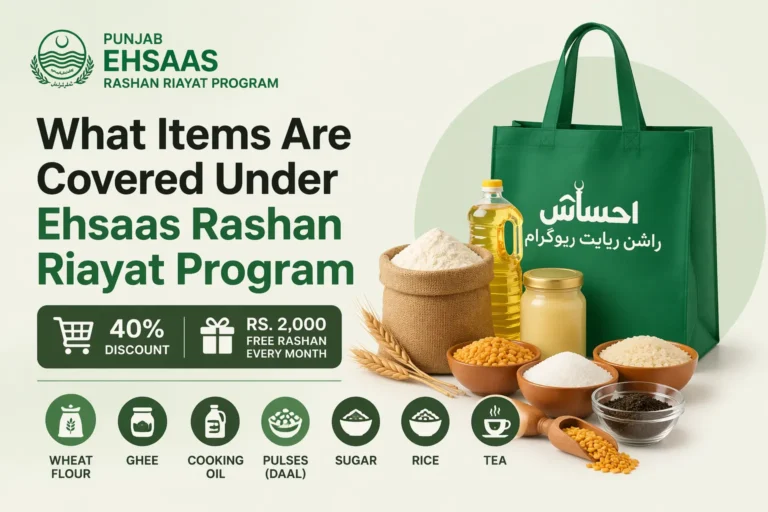
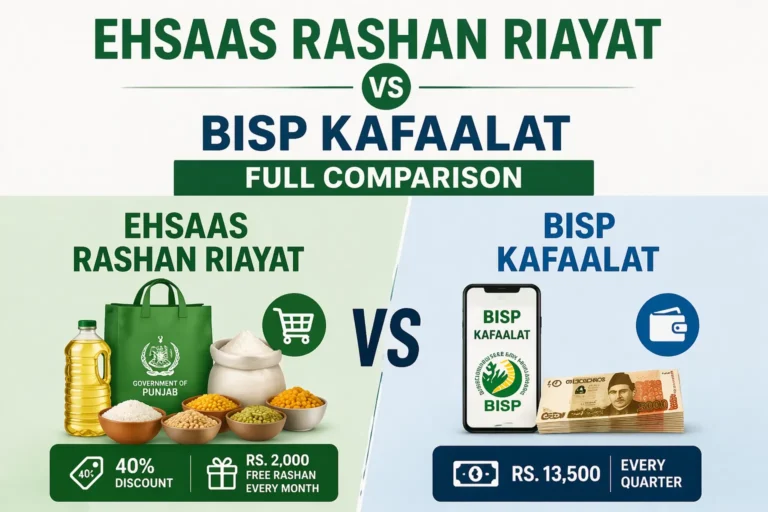
This is the program most relevant to families in Punjab who need food support. It gives eligible households a 40% discount on flour, ghee, oil, pulses, sugar, rice, and tea every month. Families also receive Rs 2,000 free rashan monthly. The National Bank of Pakistan runs this program and uses a digital biometric system at registered stores to distribute benefits fairly.
Check eligibility by sending your CNIC to 8123. Register at ehsaas.punjab.gov.pk or by calling 1000.
Ehsaas Kafaalat – BISP
Ehsaas Kafaalat is the cash transfer arm of the program. It is run by the Benazir Income Support Programme and targets the poorest women across all of Pakistan. Beneficiaries receive Rs 13,500 every quarter paid directly to a mobile wallet or through partner banks.
The program specifically focuses on women because research shows that when women control household finances the whole family benefits. Around 9 million women across Pakistan receive this payment. Check eligibility by sending your CNIC to 8171.
Ehsaas Nashonuma
This program addresses one of Pakistan’s most serious long-term problems — child malnutrition. Pakistan has one of the highest rates of stunted growth in children in the world. Ehsaas Nashonuma provides financial support to pregnant women and mothers of children under two years of age so they can afford proper nutrition during these critical years.
Registered families receive cash incentives to spend on nutritious food for the mother and child. The program focuses heavily on rural areas where malnutrition rates are highest.
Ehsaas Taleemi Wazaif
Many poor families pull their children out of school because they cannot afford even basic school expenses. Ehsaas Taleemi Wazaif fights this problem by giving educational stipends directly to children of BISP registered families.
The stipend is given on the condition that the child maintains regular school attendance. Girls receive a slightly higher amount to encourage families to keep their daughters in school. This program has helped raise enrollment rates significantly in rural and low income areas.
Ehsaas Undergraduate Scholarship
This program helps talented students from lower middle class backgrounds go to university. Many capable young people cannot afford higher education even when they have the grades for it. Ehsaas Undergraduate Scholarship covers tuition and living expenses for students from families that cannot fund a university degree on their own.
The scholarship focuses on students in fields like engineering, medicine, and technology where the cost is highest and the impact on the economy is greatest.
Ehsaas Interest Free Loans
One of the biggest barriers for poor people trying to start a business is access to capital. Banks require collateral and charge high interest rates which most poor families cannot handle. Ehsaas Interest Free Loans removes this barrier by giving small business loans at zero interest to qualifying applicants.
Women in rural areas are a primary target for this program. A woman who knows how to sew, cook, or do craftwork but has no capital to buy materials or equipment can get this loan and turn her skill into a real income. This has helped thousands of women become financially independent.
Ehsaas Aamdan Program
Sometimes money alone is not enough. Poor families need actual income generating tools. The Ehsaas Aamdan Program provides physical assets like sewing machines, livestock, shop stock, and vehicles to poor individuals so they can earn a sustainable income over the long term.
This is different from a cash transfer or loan. The asset belongs to the family and can generate income for years. A family that receives a cow for example can sell milk every day and create a steady income stream without depending on government payments.
Ehsaas Langar
Food insecurity is worst for people who have no home or no stable income at all — daily wage workers, the homeless, and seasonal laborers. Ehsaas Langar provides free hot meals at langar khanas set up in cities and towns across Pakistan.
This program makes sure that even the most vulnerable people who do not have a CNIC or cannot register for other programs still have access to at least one proper meal each day.
How Ehsaas Uses Technology to Prevent Fraud
One of the biggest differences between Ehsaas and older welfare programs is the use of technology. Every program under the Ehsaas umbrella uses CNIC-based digital verification through NADRA. This means the government can check in real time whether someone is eligible, whether they have already received a payment, and whether the information they provided is accurate.
Biometric verification at the point of payment makes it nearly impossible to collect on behalf of someone else. The digital record of every transaction means money cannot disappear without a trace. This system has dramatically reduced corruption compared to older paper-based distribution methods.
Ehsaas and Women Empowerment
A striking feature of the entire Ehsaas Program is how much it focuses on women. More than 50% of all Ehsaas benefits go directly to women. Programs like Kafaalat register women as the primary account holder. Interest free loans target women entrepreneurs. Taleemi Wazaif gives extra stipends for girls to stay in school. Nashonuma specifically supports mothers.
This focus is intentional. When women have financial independence they make better decisions for their children’s health and education. The ripple effect of empowering women benefits entire families and communities for generations.
Is the Ehsaas Program Still Running in 2026
Yes. While the name and structure of some programs have evolved over time the core welfare work continues under different governments. The Punjab Ehsaas Rashan Riayat Program is actively running in 2026. BISP Kafaalat payments of Rs 13,500 per quarter are being distributed. Taleemi Wazaif stipends continue for enrolled children. The system is alive and helping millions of families right now.
Conclusion
The Ehsaas Program is much bigger than most people realize. It is not just one scheme — it is a full system of support covering food, cash, education, health, nutrition, skills, and business tools for the poorest people in Pakistan.
If you or your family needs help the first step is to check which program you qualify for. For food support in Punjab send your CNIC to 8123. For national cash support send your CNIC to 8171. For any other query call 0800-26477 or visit ehsaas.punjab.gov.pk.
The support is real, it is ongoing, and it is available to your family today.